.png)
Corcovado National Park: The Complete Guide (from someone who slept inside the jungle)
We'll be honest with you: we almost didn't go. Corcovado National Park is remote, it's not cheap, and sleeping in a jungle dormitory without a fan while howler monkeys scream at 4 AM doesn't exactly sound like a vacation.
But standing outside the Sirena Station at 9 PM, watching a wild Baird's tapir emerge from the darkness and walk calmly past us after dinner? That's the moment you realize there is nowhere else on Earth quite like this.
We visited Corcovado on June 1st and 2nd with our trusted guide Santos, a Tico from Puerto Jiménez who turned out to be a walking encyclopedia of wildlife and biodiversity. We stayed overnight at Sirena Station, deep inside the park, and came back with a full notebook of notes to help you plan the perfect trip.
Whether you're planning a full-day tour or a 2-day overnight adventure, this is everything you need to know.

Table of Contents
What is Corcovado National Park?
Corcovado National Park sits at the southern tip of the Osa Peninsula in Costa Rica's Pacific South region — and it is, without exaggeration, one of the most biodiverse places on the planet. National Geographic once described the Osa Peninsula as "the most biologically intense place on Earth," and this park is the heart of it.
Created in 1975 to protect the last remaining primary lowland rainforest in Central America, Corcovado covers over 41,000 hectares of pristine jungle, coastal beach, wetlands, and mangroves. The park protects more than 13 distinct ecosystems, 500 species of trees, 140 species of mammals, and over 370 species of birds — many of them found nowhere else in Costa Rica.
This is not a zoo. This is the real, raw, wild Costa Rica. And visiting it requires a certified guide, planning, and a genuine sense of adventure.
Why visit Corcovado? (and is it worth it?)
Short answer: yes. Absolutely, unequivocally yes.
Corcovado is the only place in Costa Rica where you have a realistic chance of seeing a Baird's tapir in the wild. It's one of the last places in Central America where jaguars still roam freely. It has all four of Costa Rica's monkey species in one place. And the sheer density of wildlife you encounter here — in a single hike — is unlike anything we've seen in Manuel Antonio, Monteverde, or Tortuguero.
What makes Corcovado truly special is how intact the ecosystem is. Because access is strictly controlled and visitor numbers are limited, the animals here are not used to human presence. Every sighting feels earned and real.
Who is Corcovado for?
Nature lovers and wildlife photographers
Hikers and adventure travelers
Anyone who wants to see the "real" Costa Rica
Travelers willing to embrace some discomfort in exchange for an extraordinary experience
Who might want to reconsider?
Travelers looking for a relaxing beach vacation
Anyone with serious mobility issues (trails are flat but muddy, with river crossings and roots)
Those who want guaranteed luxury — it's really hot and very humid, the Sirena Station is very basic.
Our Experience: 2 Days, 1 Night at Sirena Station
Day 1: Boat adventure and jungle exploration
We arrived at the Drake Bay meeting point at 5:50 AM on June 1st.
The boat ride from Drake Bay to Sirena takes about 1.5 hours along the Pacific coast. The sea was choppy that morning, but manageable. When we landed on Playa Sirena, the boat pulled as close to shore as possible, and we waded in — so pack water shoes or be prepared for wet feet from the start.
Our guide Santos — a native of Puerto Jiménez who has been guiding in Corcovado for years — was there waiting for us.
Santos is the kind of guide you hope for. He's the kind of character you won't forget. He can identify a bird by its call from 50 meters away, spot a sleeping sloth in a canopy that looks like solid green to the untrained eye, and explain the chemical relationship between a leaf-cutter ant and its fungal garden with the enthusiasm of someone sharing the most exciting secret in the world. We've worked with top guides through Pura Vida Traveling for more than five years — Santos is one of the best.
When you get off the boat, you have a space to rinse your feet, put on your hiking boots, go to the toilet if you need to, and you can report to the park rangers; you will simply have to fill out the register with your name, date, passport number, and show the contents of your bags (no food or plastic bottle allowed in the park)
Then the guide will take you to the Rangers station Sirena, where you will find out where you will sleep for the night, leave your bag with your change of clothes and belongings for the night.
The first breakfast is not included, so we bought some biscuits at the small grocery store in the station, a coffee, and set off for our first trail of the day.
We spent the morning hiking the trails around Sirena Station. During the first two hours, we spotted spider monkeys, squirrel monkeys, a herd of wild boars with piglets, a toucan, about ten different bird species whose names I can't recall, lizards, iguanas, scarlet macaws (always in pairs—they mate for life), and learned a great deal about the rainforest and its various trees.
Santos would stop every few minutes. "Listen," he'd say, holding up a hand. And then he'd point somewhere in the canopy that looked completely unremarkable, and through his spotting scope you'd see a golden-crowned woodpecker perched perfectly still in the shade.
After this first morning full of information, we returned to the Sirena station around 1:00 PM for a traditional Tico lunch — rice, black beans, salad, vegetables, eggs or pork, and a fresh fruit juice. Simple but very nourishing
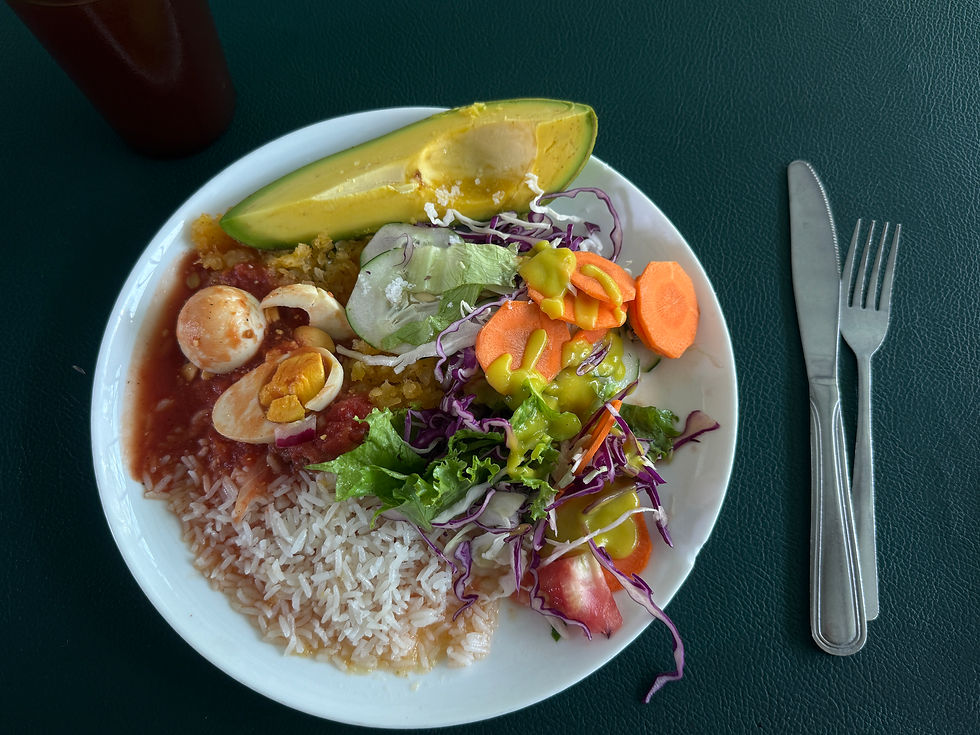
A short break for rest and a quick nap on the ground (the station doesn't really offer a "relaxation" area), and we're off again for the afternoon.
After the day-trippers left on the 1:00 PM boat, the park changed. The trails went quiet. That's when the real magic happened.
At 4 PM, we again came across a group of wild boars crossing the path 2 meters from us. And 30 minutes later, we were surrounded by a group of about thirty coatis, babies, and adults; it was quite incredible to find ourselves in the middle of this general commotion. Squirrel monkeys again, several species of birds, including a cousin of the majestic Quetzal.
We returned to Sirena station around 6:30 pm for a refreshing cold shower and dinner: vegetarian quesadilla or pork chop, salads, vegetables, and of course rice and beans. Surprise: a slice of apple cake and a natural juice.

As we were serving ourselves dinner, one of the park guides came to tell us that a tapir was crossing the garden in front of the station; we all ran to the veranda to admire it, but it was already quite far away.
After dinner, while sitting on the station veranda watching the darkness of the jungle with our flashlight, several times we saw nothing, and suddenly we heard a rustle near the edge of the tree line. A tapir wandered out, sniffed the air, and disappeared again. Amazing moment.
Sirena Station: what to expect?
Sirena is not a hotel. It's a fully functioning ranger station that was designed to allow visitors to sleep inside one of the world's most biodiverse national parks. That's extraordinary. That's also the only way to frame what you're getting.
The facilities:
Two open-air dormitory rooms with bunk beds
Each bunk has a mosquito net, a mattress, a fitted sheet, a pillow, and a top sheet
4–5 showers and restrooms per gender
A dining hall, a souvenir shop, and a small natural history museum
A veranda overlooking the forest — where you'll want to spend every spare moment
Free Wi-Fi in the common area (the connection was barely working for us; bring a book or a card game)
Cold showers only (no hot water)
Filtered drinking water stations — bring a reusable bottle; single-use plastics are confiscated at the entrance
Limited outlets for charging; bring a fully charged power bank
Lights out at 8 PM sharp
What's available to rent: rain boots (highly recommended in the wet season), towels, lockers — all around $5 USD.
The Night
We were extremely tired from walking in the jungle that day, so we went to bed around 8 PM. We'll be honest: you're not going to sleep brilliantly at Sirena Station. The dormitory can hold up to 80 people, including guides. In high season, it's often at capacity. The dormitories are large open-air rooms with bunk beds, mosquito nets, and no fans. The jungle is never silent — the insects, frogs, and howler monkeys make sure of that. It rained hard around midnight, which was both beautiful and extremely loud on the metal roof.
Bring earplugs. Bring a sleep mask. Set your expectations accordingly. It is not comfortable. It is also completely, utterly worth it.
Day 2: Dawn in the Rainforest
We were up at 4:30 AM — not by choice, but because the howler monkeys made it very clear that dawn was happening and they wanted everyone to know. We were on the trails by 5 AM.
There is something about the jungle at dawn that no daytime hike can replicate. The light filters through the canopy in streaks. The air smells like rain and soil and something alive. Everything is moving. We saw camaian in the river, more spider monkeys swinging through the canopy, herons, caracaras, and vultures gathering in a big fig tree near the river.
We returned to the station around 7:30 AM for breakfast and to pack our belongings (check-out is at 8:00 AM, but you can leave your bags at the station; there are cameras in the common areas, and lockers are available). We left our bags under the surveillance cameras and weren't stressed at all; the people participating in this kind of experience aren't the type to steal your belongings.

At 9 AM, we'll be off again for another walking tour until 12 PM, when you'll return to the Sirena station one last time to have lunch and say goodbye to this special place and our guide before taking the boat back to Drake Bay at 1:00 PM
By the time we arrived back in Drake Bay around 2 PM, we were slightly sleep-deprived but completely in love with this place.
Our verdict: 2 days, 1 night is the ideal way to experience Corcovado. It is pricier than a day trip, but the overnight access to the park — the afternoon hours after day-trippers leave, the dawn walks, the nocturnal wildlife near the station — is what transforms a good tour into an unforgettable one.
How to get to Corcovado National Park?
Getting to Corcovado is part of the adventure. There are several ways to reach the park, and the right option depends on where you're coming from and how much time you have.
Option 1: Fly to Puerto Jiménez
The fastest and most comfortable option. Domestic flights from San José (SJO) to Puerto Jiménez (PJM) take about 45 minutes with airlines like Sansa. From Puerto Jiménez, all guided tours to Sirena Station depart by boat from the main dock.
Option 2: Fly to Drake Bay
If you prefer to access the park from the north (San Pedrillo Station) or want to be based in Drake Bay, this is a great option. Daily flights connect San José to Drake Bay (DRK) in about 45 minutes.
Option 3: Drive to Puerto Jiménez
From San José, it's approximately a 5–6 hour drive to Puerto Jiménez via the Costanera Sur highway. You'll need a 4WD vehicle, especially if you plan to visit during the rainy season. Once in Puerto Jiménez, leave your car at your hotel and depart by boat.
Option 4: Boat from Sierpe to Drake Bay
Drive to Sierpe (about 4–5 hours from San José), then take a 1.5-hour boat ride through the mangrove estuary to Drake Bay. From Drake Bay, you can access the northern sector of the park (San Pedrillo Station) by boat. Check our guide on how to get to Drake Bay from Sierpe for the full details.
When to visit Corcovado National Park?
Dry Season (December – April):
The best weather for hiking. Sunny days, minimal rain, and peak wildlife visibility. This is also peak tourist season, which means Sirena Station overnight spots — limited to around 80 people total, including guides — sell out fast. Book at least 30 days in advance.
Green/Rainy Season (May – November):
Fewer tourists, lusher vegetation, and wildlife are just as active. Mornings are typically dry; afternoon rains kick in around noon or 1 PM. October is the rainiest month. If you visit during this period (as we did in June), bring a waterproof pack cover and accept that you will get wet.
Our tips: read our article "When is the best time to visit Costa Rica?" to better understand Costa Rica's seasons.
Our experience visiting in June:
We had a gorgeous first day — sunny, partially cloudy, perfect hiking conditions. A little rain in the early afternoon, but nothing serious. We saw more wildlife than most dry-season visitors report. The tradeoff is worth it for the smaller crowds and lower prices.
One thing that doesn't change with the season: temperature. Average daytime highs hover around 29°C (85°F) with humidity between 80–90%. It is hot, sticky, and in some ways wonderful. Be prepared to sweat and get wet throughout your entire experience.

Where to stay near Corcovado National Park?
Puerto Jiménez is the main gateway and has the widest range of accommodations — from budget guesthouses to eco-lodges. It's the best base if you're doing a Sirena Station tour. Many hotels will let you leave your car and luggage while you're overnight in the park.
Drake Bay is a small fishing village on the northern side of the Osa Peninsula, accessible by boat or small plane. Great for access to San Pedrillo Station and for a more off-grid experience. Accommodation ranges from simple lodges to higher-end eco-resorts.
Carate is a tiny village right at the park's La Leona entrance, for those who want to be as close to the jungle as possible. Very limited accommodation and facilities.
Uvita is a convenient departure point for the San Pedrillo Station tour via boat along the Pacific coast. It's a great option if you're doing a day trip from the Costa Ballena region without wanting to travel all the way to the Osa.
Inside the park: As you have probably read previously, Sirena Station offers basic dormitory accommodation for overnight visitors. You sleep inside the National Park itself. All meals are included. Maximum capacity is around 80 people (including guides). Lights out at 8 PM. Read our section "Sirena Station: What to expect when you arrive" for more information.
How to book: tickets, tours & what to know before you go
Booking in advance is non-negotiable
Every visitor to Corcovado National Park must have a certified guide and a park entrance ticket purchased in advance. You cannot walk in off the street. Each ranger station (Sirena, San Pedrillo, La Leona, Los Patos, El Tigre) has a maximum daily visitor limit.
Sirena Station is the most popular and sells out the fastest. In high season, spots for overnight stays are often fully booked months in advance.
During high season (December–April): Book at least 30 days in advance.
During low season (May–November): Book as early as possible — less competition, but spots still fill up.
If your trip is in less than 3 days, Tour operators typically cannot guarantee a park ticket. Plan ahead.
What your tour operator handles
Your guide or tour company will purchase your park ticket. You'll need to provide: full name, passport country, passport number, and age. Keep this information ready when booking.
Approximate costs
Day trip from Drake Bay: Around $130 USD per person
Day trip from Puerto Jiménez: Around $190 USD per person
2-day/1-night overnight from Puerto Jiménez or Drake Bay: Around $390 USD per person
All overnight packages include all meals (from pick-up to return), lodging at Sirena Station, bilingual naturalist guide, national park fee, and boat transportation. Not included: locker rental ($5), towel rental ($5), rain boots (available for rent at the station).
Tour Options: choose your adventure
From Uvita: Full-Day San Pedrillo Station Tour
A scenic full-day adventure departing by boat along the Pacific coast to Corcovado's San Pedrillo Station. This is the most accessible option for travelers based in Uvita or the Costa Ballena region. Includes certified naturalist guide, park entrance, boat transportation, and a picnic lunch.
From Puerto Jiménez or Drake Bay: 1-Day Sirena Station Tour
The full-day Sirena tour departs early morning by boat and gives you 4–5 hours of guided hiking through the park's core wildlife zone. Includes boat transfers, park fee, bilingual guide, and lunch.
2-Day / 1-Night Sirena Station Overnight
Our top recommendation. You arrive with the morning day-trippers, but you stay after they leave. You get the golden afternoon hours when wildlife emerges, the nocturnal activity around the station after dark, and the extraordinary pre-dawn walks on Day 2. All meals, lodging, guide, and transfers are included.
3-Day / 2-Night Sirena Station Tour
For travelers who want maximum immersion. Two nights inside the park means early morning, midday, afternoon, and nocturnal access to the trails. The best option for wildlife photographers and serious nature enthusiasts.
Hike In vs. Boat In: what's the difference?
Most visitors boat in and out of Sirena, which is comfortable and efficient. If you're in excellent physical condition, you can hike in from La Leona Station (16 km one way through dense jungle) or Los Patos Station (20 km one way with river crossings). Both hikes are intense but deeply rewarding — you experience far more of the park's interior. A guide is mandatory for all hikes.
What to pack for your Corcovado Adventure?
The essentials:
Reusable insulated water bottle (mandatory — no single-use plastics)
Insect repellent (DEET or strong natural formula — apply before bed as well)
Long lightweight hiking pants or shorts if you're making sure to use insect repellent
Moisture-wicking t-shirts
Waterproof rain jacket + pack cover or dry bags (essential May–November)
Hiking shoes or trail runners (closed-toe required on trails)
Small day pack for hikes
Sunscreen and hat
Binoculars — even if you're not a photographer, you'll want them
For overnight stays:
A change of clothes for day 2 and clothes for the night, something light, it's really hot)
Larger bag for overnight gear
Towel
Earplugs and sleep mask (for overnight stays)
Toiletries (shampoo, soap, toothbrush)
Flip flops for inside the station (shoes are not allowed inside)
For photographers:
Telephoto lens, minimum 300mm (Santos will spot things at incredible distances)
2–3 spare fully charged batteries
Extra SD cards
Monopod or tripod for the veranda
Waterproof camera bag or rain cover
Wildlife you can expect to see in Corcovado
No wildlife sighting is ever guaranteed, but Corcovado has a higher hit rate than anywhere else we've visited in Costa Rica. Here's what you have a realistic chance of seeing:
Almost certainly: Scarlet macaws (in pairs), white-faced capuchin monkeys, howler monkeys, spider monkeys, iguanas, crocodiles, great curassows, herons, ospreys, vultures
Very likely: Baird's tapir (especially in the late afternoon and near the station), peccaries, coatis, agoutis, motmots, trogons, toucans
Possible but not guaranteed: Poison dart frogs, sea turtles (on the beach), dolphins (on the boat ride), humpback whales (December–March and July–October)
Rare but possible: Jaguars, pumas, ocelots — Corcovado has healthy populations of all three, but sightings are uncommon and usually happen on overnight stays when day-trippers have left
Sloths: Less commonly spotted than in Manuel Antonio National Park due to the dense canopy, but a good guide will find them. Santos found one within the first 30 minutes.
Tips from our guide Santos (and from us)
Book early. Sirena overnight spots are limited to ~80 people. They sell out. Don't wing it.
Do the overnight if you can. The wildlife ratio in the late afternoon, after day-trippers leave, is dramatically better.
Bring binoculars. Your guide will have a spotting scope, but there will be a queue. Your own binoculars mean you never miss a moment.
Don't swim. The beaches look beautiful. The currents are dangerous. There are sharks and crocodiles in the water. Admire from shore.
Respect the silence. Talk quietly, move slowly, and follow your guide. The animals notice you before you notice them.
Trust your guide. Santos once stopped us mid-sentence, held up a hand, and 20 seconds later, a group of coatis walked out of the undergrowth onto the trail. We would have walked right past it.
Wear clothes you don't mind ruining. The mud is relentless, the humidity is extreme, and you will sweat through everything within the first hour.
Budget an extra night in Puerto Jiménez or Drake Bay after your return. After a night at Sirena, you will be exhausted. Don't try to drive 5 hours home or catch a connecting flight. We personally drove from Drake Bay to Quepos, about 4 hours, and it was quite tiring. Try to recover first if you can.
Final Tips for Visiting Corcovado National Park
Book tours in advance: Corcovado is a very popular destination, so advance booking of tours and accommodation is recommended.
Respect nature: Corcovado is a protected area, so be mindful of the environment and follow all park rules, including not disturbing wildlife.
Prepare for the heat and humidity: The Corcovado climate can be stifling, so drink plenty of water, wear sun protection, and take breaks if necessary.
Expect the unexpected: Wildlife sightings are never guaranteed, but Corcovado's natural beauty will leave you in admiration, whatever creature you encounter.
Conclusion
Corcovado National Park is undoubtedly one of Costa Rica's most extraordinary destinations, and it is a must-visit destination for anyone seeking Costa Rica’s wild beauty. Whether you're interested in wildlife, adventure, or simply immersing yourself in the beauty of nature, a visit to Corcovado is sure to be one of the highlights of your trip. Ready to embark on this adventure? Let Pura Vida Traveling take care of your sightseeing and transportation needs to make your Costa Rican dream come true!
From boat rides along the Pacific coast to overnight stays in the heart of the jungle, every tour offers a unique adventure and unforgettable encounters with nature. Pair your Corcovado experience with other Costa Rica activities, like Caño Island snorkelling or Osa Peninsula wildlife watching, to make the most of your trip.
No matter your travel style — backpacker, solo explorer, or family traveler — Corcovado promises memories that will last a lifetime. Explore, connect with nature, and live the true Pura Vida.
Ready to plan your Corcovado Trip?
We offer guided Corcovado tours departing from Uvita, Puerto Jiménez, and Drake Bay — day trips and overnight experiences with handpicked certified naturalist guides.
Questions? WhatsApp us directly at +506 8826 3163. We've been to Corcovado ourselves. We know the park, we know the guides, and we'll help you put together an experience you'll be talking about for years.
Frequently Asked Questions
Can you enter Corcovado National Park without a guide?
No. A certified guide is mandatory for all visitors. The park is remote, the trails can be dangerous, and wildlife encounters require professional supervision. This rule is strictly enforced at all ranger stations.
Are there jaguars in Corcovado National Park?
Yes. Corcovado has the largest jaguar population in Costa Rica. Sightings are rare — jaguars are solitary, largely nocturnal, and excellent at avoiding people — but they are genuinely present. The overnight experience gives you the best odds.
How much does it cost to go to Corcovado National Park?
Tour prices range from $110 to $180 USD per person for a day trip and from $350–$450+ USD per person for a 2-day overnight, including all meals, guide, park fees, and boat transfers. Private tours cost more. The investment is significant; the experience is worth it.
Is Corcovado National Park worth it?
Absolutely! We're two people who have lived in Costa Rica for years and visited dozens of its national parks. Corcovado is genuinely different. The density and diversity of wildlife, the remoteness, the rawness of it — there's nothing else like it in Central America. Yes. It is completely worth it.
How do I travel to Corcovado National Park?
You can access Corcovado National Park through Puerto Jiménez or Drake Bay. From Puerto Jiménez, you can take a guided tour via boat or 4x4 vehicle to the La Leona or Los Patos entrance. From Drake Bay, you’ll typically take a boat to the San Pedrillo or Sirena ranger stations. All visitors must enter with a certified guide, so it’s best to book a tour in advance.
Can you swim at Corcovado National Park?
We'd strongly advise against it. Strong rip currents, sharks (bull sharks and hammerheads are present offshore), and crocodiles in the rivers make swimming genuinely dangerous. Enjoy the scenery from the shore.
Are there sloths in Corcovado National Park?
Yes, but they're harder to spot than in Manuel Antonio due to the dense forest canopy. A skilled guide will find them. Expect two-toed and three-toed sloths in the tall trees along the trails.
Is it safe to hike in Costa Rica without a guide?
It depends on the location. Many national parks and trails in Costa Rica are safe to hike independently, especially well-marked ones like those in Monteverde or Arenal. However, for remote or challenging areas like Corcovado or Rincon de la Vieja, a guide is highly recommended for safety reasons, as these places have wildlife encounters, river crossings, and unpredictable terrain. Always research the specific trail before going solo.
What is Sirena Station like for sleeping?
Basic dormitory bunk beds with mosquito nets, no AC or fans, cold showers, and lights out at 8 PM. The jungle is noisy day and night. Bring earplugs. It's not comfortable — but you're sleeping inside one of the most biodiverse national parks on Earth, and that's not something most people ever get to do.
Is Corcovado safe?
Yes, with a guide. The trails are well-maintained and clearly marked. Wildlife is wild — meaning you keep your distance and follow your guide's instructions — but there are no dangerous situations as long as you respect the park's rules. The risks come from the terrain (muddy, slippery, hot) and from people who try to wander off alone