
Top Benefits of Doing a Yoga Teacher Training Abroad (Costa Rica Edition)
- Aurélise Leroux

- Oct 29, 2025
- 9 min read
If you’re considering taking your yoga practice to the next level, doing a Yoga Teacher Training (YTT) abroad can be a powerful choice, and doing it in Costa Rica? That takes the experience into another realm. In this article, we'll explore the many benefits of doing a YTT abroad—especially in Costa Rica—and how it may just transform not only your yoga skills, but your life.
If you want to explore programs in detail, check out our guide: How to Choose the Right Yoga Teacher Training in Costa Rica.
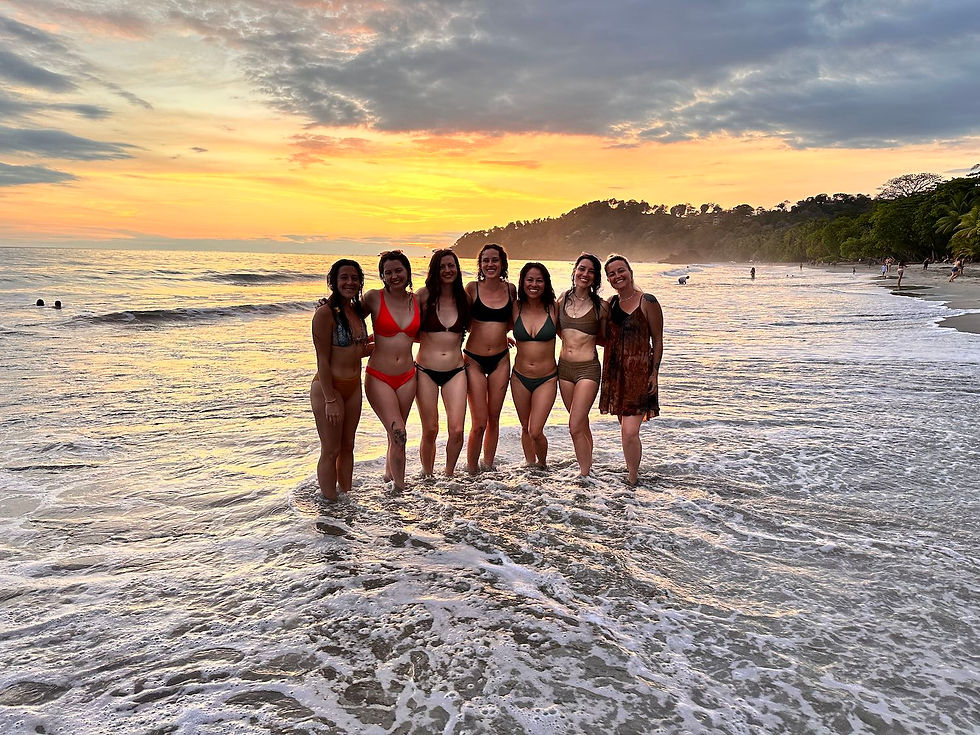
What makes “Abroad + Costa Rica” a unique combination
Costa Rica is a prime destination for YTT for many reasons.
Before we dig into the benefits, here are some of the unique features this country brings to the table:
Natural beauty: rainforests, beaches, volcanoes, waterfalls, abundant wildlife. The outdoor environment supports healing, reflection, and nature-centered practice.
Wellness & eco-tourism culture: many retreat centers, schools, and communities in Costa Rica are deeply invested in holistic practices, sustainability, plant-based or clean food, and connection to land.
“Pura Vida” lifestyle: this relaxed, appreciative approach to life helps people slow down, unplug, and open to new learning and inner growth.
Given that backdrop, let’s dive into the top benefits of doing a YTT abroad, with a focus on Costa Rica.
Top Benefits of Doing a YTT Abroad (Costa Rica Edition)
Here are the main benefits you’ll often get when you choose to do your Yoga Teacher Training abroad, and why Costa Rica in particular maximizes many of those benefits.
1. Deeper Immersion & Less Distraction
One of the strongest advantages of going abroad for YTT is that you step out of your daily routine—your usual obligations, distractions, habitual stresses—and you can fully dedicate yourself to practice, study, and inner work.
Focused learning: Without the pull of your job, social media, home chores, you often absorb more deeply. You spend more time practicing asana, pranayama, meditation, philosophy, and reflection.
Routine reset: Being in a new environment gives you permission (and often the structure) to build a more supportive daily routine: early mornings, regular meditation or journaling, healthy meals, time in nature.
Costa Rica supports immersion: Many training programs here are in natural or remote settings, often including open-air shalas, jungle or beach surroundings, which naturally reduce electronic or urban noise.

2. Physical & Mental Rejuvenation
A YTT abroad is not just about teaching yoga—it tends to be restorative and healing in many ways.
Nature as medicine: The clean air, the sounds of wildlife, ocean or river, green forest — these are inherently calming, grounding, and restorative. Studies and reports from YTTs in Costa Rica often mention waking up to bird calls, practicing overlooking jungle or ocean views etc.
Rest from daily stress: When you remove or reduce stressors (commuting, work deadlines, urban noise), your nervous system begins to reset—meditation, breath work, and time in nature help with reducing anxiety and improving sleep.
Healthy diet & movement: Many programs include wholesome food, often vegetarian or plant-based, and you are moving every day, stretching, twisting, building strength, flexibility, which leads to physical benefits beyond what a casual home practice might offer.
3. Personal Growth, Self-Discovery & Transformation
Doing YTT in another country forces you (in a good way) to grow, change, adapt, and often tremble a little outside your comfort zone.
Pushing boundaries: New culture, new people, possibly new language or customs — all of this pushes you out of comfort zones. You learn to navigate uncertainty, which builds resilience.
Self-reflection & awareness: With more space and fewer distractions, there’s more opportunity for introspection: journaling, meditation, reflective practices. You may encounter internal blocks, fears, and beliefs in ways that are more challenging when you are in your usual environment.
Spiritual deepening: Many YTT curricula include philosophy, energetic anatomy, and yogic ethics. Being abroad (especially somewhere like Costa Rica with its nature, slower pace, holistic wellness focus) often amplifies spiritual insight or offers space for inner transformation.
4. Cultural Exposure & Broader Perspective
Travel broadens the mind. Doing YTT abroad means you don’t just learn yoga – you learn from the place, from the people, from the culture.
Learning local wisdom: In Costa Rica, there is often integration of indigenous or local traditions, respect for land, ecological awareness, and a focus on sustainability. These become part of the training experience.
Meeting people from many backgrounds: YTTs draw students internationally. You’ll meet people who see life differently, have different practices, stories, and you learn from them. Those connections often last long after the training ends.
Language, customs & simplicity: There may be language barriers or cultural ways of doing things that differ — this challenges you to adapt, to soften judgments, to be more curious.
5. Value & All-Inclusive Convenience
While traveling abroad may feel expensive, many YTTs abroad offer value in ways that can offset or even exceed local training when you consider all that’s included.
Accommodations, meals, materials often included: Many programs bundle lodging, meals, yoga props, materials, sometimes even transfers. This saves time and mental energy (you don’t have to coordinate everything yourself). YogaEastWest, for example, notes that international immersion trainings are often “all-inclusive,” which means you don’t need to think about cooking, cleaning, or daily logistics.
Better “bang for buck” when factoring in everything: If you compare tuition + lodging + meals + travel vs doing something locally with separate costs, abroad can be competitive.
Boosted motivation & commitment: When you invest time, money, and commit to travel, often you are more motivated to follow through, engage fully, and take the training seriously.
6. Better Teaching Skills & Confidence
If you plan to teach, or even just want to share yoga in your personal or community space, doing YTT abroad often accelerates your readiness.
Real practice teaching: Most programs include peer-teaching, assisting, leading classes, giving feedback. The amplified intensity of immersion means you are doing more human-to-human interaction, more observation, more refinement.
Learning to adapt: Because abroad, with different students, different body types, different levels, you often learn how to adjust more sensitively—both physically (modifications) and pedagogically (cues, communication).
Presence & holding space: With more opportunity to teach in different settings (outdoors, uneven surfaces, open air shala etc.), you develop greater presence, capacity to read atmosphere, to guide safely and compassionately.
7. Lifelong Benefits: Skills & Mindset That Stick
Beyond the course, many of the lessons of a YTT abroad become long-lasting tools for life.
Stress management & mindfulness: Meditation, breathing tools, philosophy—all these continue to be useful to manage stress, stay grounded, etc.
Adaptability & resilience: When you learn to adjust to new circumstances—cultural, climatic, logistical—you build resourcefulness.
Broader worldview & compassion: Exposure to different ways of living, nature, cultures tends to foster empathy, humility, and a more expansive view of life.
Teacher certification & career options: Of course, completing a certified YTT (e.g., Yoga Alliance or equivalent) gives you credentials to teach anywhere in the world, opening new possibilities for work, retreats, travel etc.
8. Nature & Environment as Part of the Curriculum
In Costa Rica, nature isn’t just scenery—it often is part of the experience and training.
Outdoor practice settings: Beachside, jungle, open-air shalas, sometimes overlooking the ocean or surrounded by forest. The environment itself enhances practice.
Eco-awareness & sustainability: Many schools integrate sustainability, respect for land, simple living, plant-based diets, and minimal waste as part of the training philosophy. This “action” memorizes the philosophy you are learning.
Sound & sensory immersion: The sounds of rain, waves, birds, insects, the smell of earth, the feel of warm, humid or fresh air—all of that deepens mindfulness.

How to maximize these benefits?
Doing YTT abroad is one thing; maximizing what you get from it is another.
Here are tips to make sure your experience, especially in Costa Rica, delivers on its potential.
Choose a program that aligns with your priorities Refer to our guide on How to Choose the Right Yoga Teacher Training in Costa Rica. Be clear on what you value: depth vs luxury, physical/intensity vs rest, group size, teacher credentials, cost vs what’s included, etc.
Prepare practically. Travel logistics, visa, what to pack (mat, clothing, insect repellent, etc.), health precautions (vaccinations or local health advisories), and budget for extras.
Set clear intentions. Before you go, reflect: Why am I doing this? What do I hope to learn, release, become? Intentions help focus and anchor your experience.
Be open & adaptable. Things may be different from what you expect. Weather, conditions, classes, people—greet differences as part of the journey.
Engage fully. Show up for all parts: the physical, the philosophical, the silent moments, the community, even the uncomfortable parts. Often growth comes in those edge experiences.
Integrate after the training. Once you return home, don’t let the learning fade. Maintain practices, connect with other students, keep reading, maybe teach or lead share classes, and embody what you’ve learned.
Considering Drawbacks & Balancing Trade-offs
To be fully realistic, there are also considerations and possible downsides. Knowing them helps you balance and plan.
Cost & travel: Flights, travel time, possibly visa costs, and transportation to remote centers can add up. Plan ahead.
Physical demands: Daily practice, early mornings, sometimes physical intensity plus weather (heat, humidity) can challenge people not used to it.
Homesickness or culture shock: Being in a new country away from familiar support systems can bring discomfort.
Less flexibility: Once committed to a training schedule, changing plans may be harder (missed days may not be easily made up).
However—with good program selection, proper preparation, and realistic expectations—these trade-offs are often outweighed by the benefits.

Why our program supports these benefits
If you’re exploring options, our offering at Pura Vida Traveling is designed to maximize many of the benefits above.
Here’s how we try to do that:
Our Yoga Teacher Training in Costa Rica is created to support immersive experiences with experienced instructors, thoughtful schedules, and settings that connect you to nature.
We build in rest and integration time so you're not overwhelmed.
Transparent about what’s included and what to expect, including lodging, food, yoga materials, etc.
We encourage students to clarify their intention, support community among trainees, offer a balance of physical practice, meditation, breath-work, philosophy, spiritual/explorative components.
By comparing programs using the factors from our “How to Choose” guide, you can see whether your YTT choice will actually deliver on the benefits listed above.
Conclusion
Doing a Yoga Teacher Training abroad—especially in a place like Costa Rica—is so much more than simply earning a certificate.
It is an opportunity for:
deep learning and immersion
physical, mental, emotional rejuvenation
spiritual growth and personal transformation
valuable life skills, broadened worldviews, and long-term benefits
If you feel called, Costa Rica offers a powerful context: nature, wellness culture, welcoming people, eco-ethical settings, and many YTT programs that aim to help you not just teach yoga, but become more present, resilient, aligned, and awakened.
If you’re ready to explore, we invite you to look at our Yoga Teacher Training in Costa Rica page for details on upcoming programs, curricula, what’s included, and more. Before you decide, our 'How to Choose the Right Yoga Teacher Training in Costa Rica' guide is a useful companion to help you pick the YTT that best aligns with your goals.
Frequently asked questions
What is a Yoga Teacher Training (YTT) abroad?
A Yoga Teacher Training abroad is a certified program that teaches yoga techniques, philosophy, anatomy, and teaching methodology in a country outside your home. It allows you to deepen your practice while immersing yourself in a new culture.
Why should I consider doing my YTT in Costa Rica?
Costa Rica offers stunning natural settings, a wellness-focused lifestyle, eco-friendly retreats, and a supportive environment for self-reflection and growth—perfect for immersive yoga learning.
How long does a typical YTT program last in Costa Rica?
Most YTT programs in Costa Rica last 2–4 weeks for a 200-hour certification. Some advanced or 300-hour programs may extend longer depending on curriculum depth.
Do I need prior yoga experience to enroll?
While some programs welcome beginners, most 200-hour YTT programs require at least basic yoga experience to ensure you can safely participate in physical practice and teaching exercises.
Will I receive a certification recognized internationally?
Yes, most reputable YTT programs in Costa Rica are Yoga Alliance certified, ensuring your certification is recognized worldwide for teaching professionally.
What are the main benefits of doing YTT abroad vs locally?
YTT abroad offers full immersion, exposure to new cultures, connection with nature, personal transformation, networking with international peers, and the opportunity to unplug from daily routines.
What should I pack for a Costa Rica YTT?
Essentials include: yoga clothes, mat, reusable water bottle, insect repellent, sun protection, lightweight layers for tropical climate, comfortable shoes for nature walks, and a journal for reflection.
How much does a YTT in Costa Rica typically cost?
Costs vary depending on location, accommodation, and inclusions, but most 200-hour programs range from $2,000 to $4,500, often including lodging, meals, training materials, and certification fees.
Can I travel and explore Costa Rica during my YTT?
Many programs allow free time or organized excursions. It’s a great opportunity to explore beaches, waterfalls, national parks, and volcanoes while balancing your training schedule.
How do I choose the right YTT program in Costa Rica?
Consider factors like certification, teacher experience, curriculum, location, lodging, group size, and personal goals. For a detailed guide, check our blog: How to Choose the Right Yoga Teacher Training in Costa Rica.


Comments